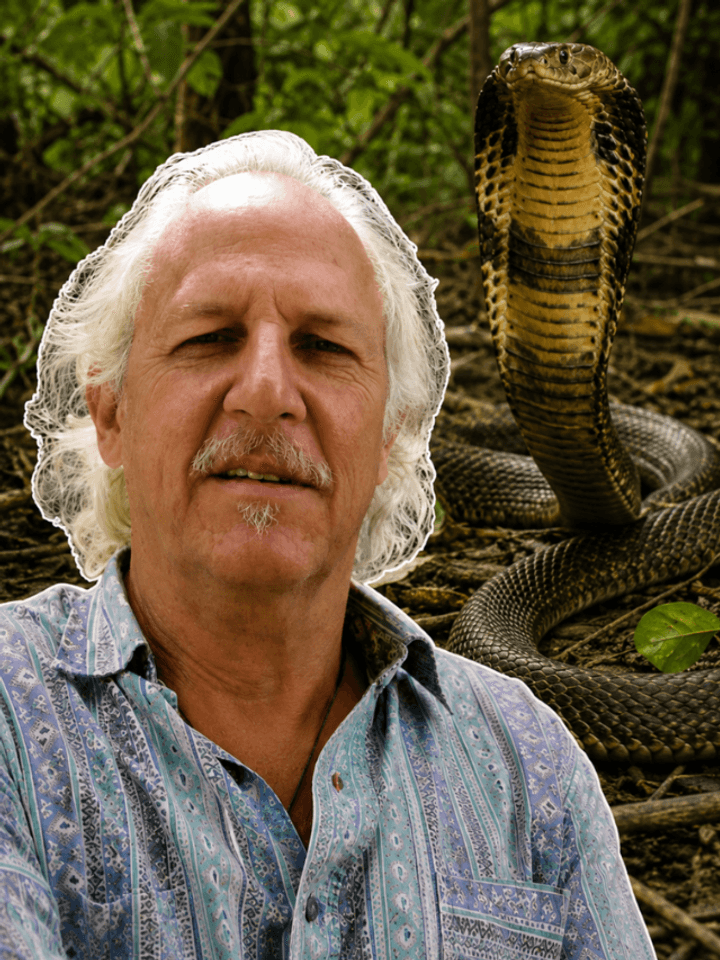
This Snake-Loving Boy Who Grew Up to Help India Get Over Its Fear of Reptiles

Photo Credit : Image generated with AI
India's Snakeman
Before India could protect snakes, someone had to convince people they were worth protecting for the ecosystem. This is the story of Padma Shri Romulus Whitaker and a lifetime spent changing minds.
Photo Credit : Cedric Bregnard
Curious beginnings
As a child, Romulus Whitaker spent hours watching black and red ants through a magnifying glass, fascinated by their tiny worlds, conflicts, and cooperation.
Photo Credit : Heyward Clamp
A mother's lesson
At age four, he brought home a dead garter snake. His mother's disappointment stayed with him. Later, when he brought home a live snake, her admiration for the creature changed everything.
Photo Credit : Doris Norden
Snake obsession
Inspired by that moment, Whitaker began searching under every stone for snakes. Soon, he was keeping milk snakes, ribbon snakes, ring-necked snakes, and brown snakes in a homemade terrarium.
Photo Credit : Heyward Clamp
Fear vs fascination
Whitaker realised something important early on: people may fear snakes, but they are also deeply curious about them. That insight would shape his life's work.
Photo Credit : Linda Ballou
First snake park
In 1969, he founded the Madras Snake Park on the outskirts of Chennai with a ticket price of just 25 paise, creating a place where people could see and learn about reptiles.
Photo Credit : Outlook India
Changing perceptions
The park was never just about displaying snakes. It was designed to replace fear with understanding and show visitors why reptiles matter in nature.
Photo Credit : Janaki Lenin
Building institutions
Whitaker went on to establish the Madras Crocodile Bank Trust in 1976 and later founded the Agumbe Rainforest Research Station in Karnataka in 2005 using an award grant.
Photo Credit : India Times
King Cobra quest
His conservation work focused heavily on rainforest biodiversity and the mysterious king cobra, helping bring attention to one of India's most misunderstood reptiles.
Photo Credit : IndulgeExpress
The Irula connection
Eventually, Whitaker formed a close bond with the Irulas, one of India's oldest indigenous communities, whose extraordinary knowledge of snakes impressed him deeply.
Photo Credit : Janaki Lenin
Friends in need
When the Wildlife (Protection) Act, 1972, ended the snakeskin trade, many Irula families lost their livelihoods. Whitaker searched for a solution that could help both people and snakes survive.
Photo Credit : Janaki Lenin
A new future
To support both the community and snake conservation, Whitaker helped create the Irula Snake Catchers' Co-operative, earning his first Rolex Award for Enterprise in 1984.
Photo Credit : magzter
Venom saves lives
In 1982, the Irula Snake Catchers' Co-operative received permission to catch India's big four venomous snakes and extract venom, which became crucial for antivenom production.
Photo Credit : Nina Menon
Protecting humans too
Despite the risks and limited access to nearby hospitals, Irula members continued their work. Today, their efforts contribute roughly 80 per cent of India's antivenom supply.
Photo Credit : Rolex Awards
Changing minds first
Across decades of rescuing snakes, and supporting indigenous communities, Whitaker's biggest lesson is: conservation begins when people learn to see value where they once saw fear.
Photo Credit : Janaki Lenin
This good news was originally reported by The Better India.
Read the full story at the source →More good news


A new law in Zambia makes free education much harder for future governments to take away
The Optimist Daily · Jun 19, 2026